
Blog
Featured


Woad (istasis tinctoria) is a biannual brassica. The leaves contain the precursors for indigo. In the summer of the first year, the leaves contain the most potential for indigo. In the early spring of the second year, the plants go to flower, these flowers transform to seeds that can be harvested in the summer of the second year.
Here are five of my favourite dye and ink plants. These are all plants you can easily grow in the UK. Buddleia - This is a perennial woody shrub/tree that grows commonly in urban industrial edges and gardens. The flowers start to bloom in June and continue throughout the Summer. The flowers are very abundant making it possible to gather large quantities without depleting the supply for the butterflies and bees who also love them. All the flowers, regardless whether they are pink, white, or yellow give a bright yellow dye. This is effective with an aluminium based mordant on silk and wool. You can also do bundle dyeing with the flowers as the flowers release their pigment quickly.
My practice with natural dyes and inks is a process of learning how to live in a more close and practical relationship with the natural world. Working with seasons, wild plants, and chemical free processes to create a culture around colour that is directly from and closely connected with the land where we live. Through roughly 13000 years of agriculture, we have become increasingly separated from nature. The synthetic dye industry, developed in the 1800s is one of the most polluting industries on the planet. Globally, the textile industry discharges 40,000 – 50,000 tons of dye into water systems every year. This cocktail of polluted water and chemicals, causes the death of aquatic life, contaminating soils and poisoning of drinking water. It is also now clear that we are living in a time of human caused mass extinction and climate chaos. We need to find a new ways of living that are more connected with the natural world.
I have been fascinated by permaculture ever since I first heard about in in 2010. I was studying design at art school at that time, and I was frustrated. I felt that there was something missing in the design methodology that we were being taught. During the summer holidays, I stumbled across an Introduction to Permaculture session at a festival, and I was so excited to learn about a design methodology that incorporated the whole natural world, and not just humans. I was keen to learn more, so the next summer, I did a two week ‘Earth Activist Training’, exploring activism, spirituality, and permaculture, run by Starhawk and Andy Goldring. This experience blew my mind and permanently shifted something in my relationship with the natural world. I
Permaculture stands for “permanent culture”, integrating human and ecological needs in to the design process.. It is a series of design ethics and principles that you can apply to any design process or system. Developed by Bill Mollison and David Holmgren in Australia in the 1070s inspired by Masanobu Fukuoka's natural farming philosophy, written in his book ‘One Straw Revolution’.
Some dye plants such as rose petals, sage, and rosemary may already be growing in your garden or easily found locally. Other dye plants, such as madder, weld, or woad will only be found in the garden of a natural dyer, so the seeds and plants can be harder to find to start your garden. I get my seeds and cuttings from a variety of different sources.
As the days grow longer and the plants mature, the butterflies are fluttering around. the flowers start to come out. Flowers are really fun to work with as they can give many colours, and not always the colour you expect. Buddleia is a great example of this as all the flowers, regardess of the colour of the petals, all give a yellow dye. This is one of our best wild sources of yellow in the UK.
Being present to receive the gifts of the land.
We live in circles.
Finding the old circles.
Woods, river, sea, river, woods.
By the call of the cuckoo, and then the blackberry.
The drum beats and seasons pass.
Leaves fall as harvest rise.
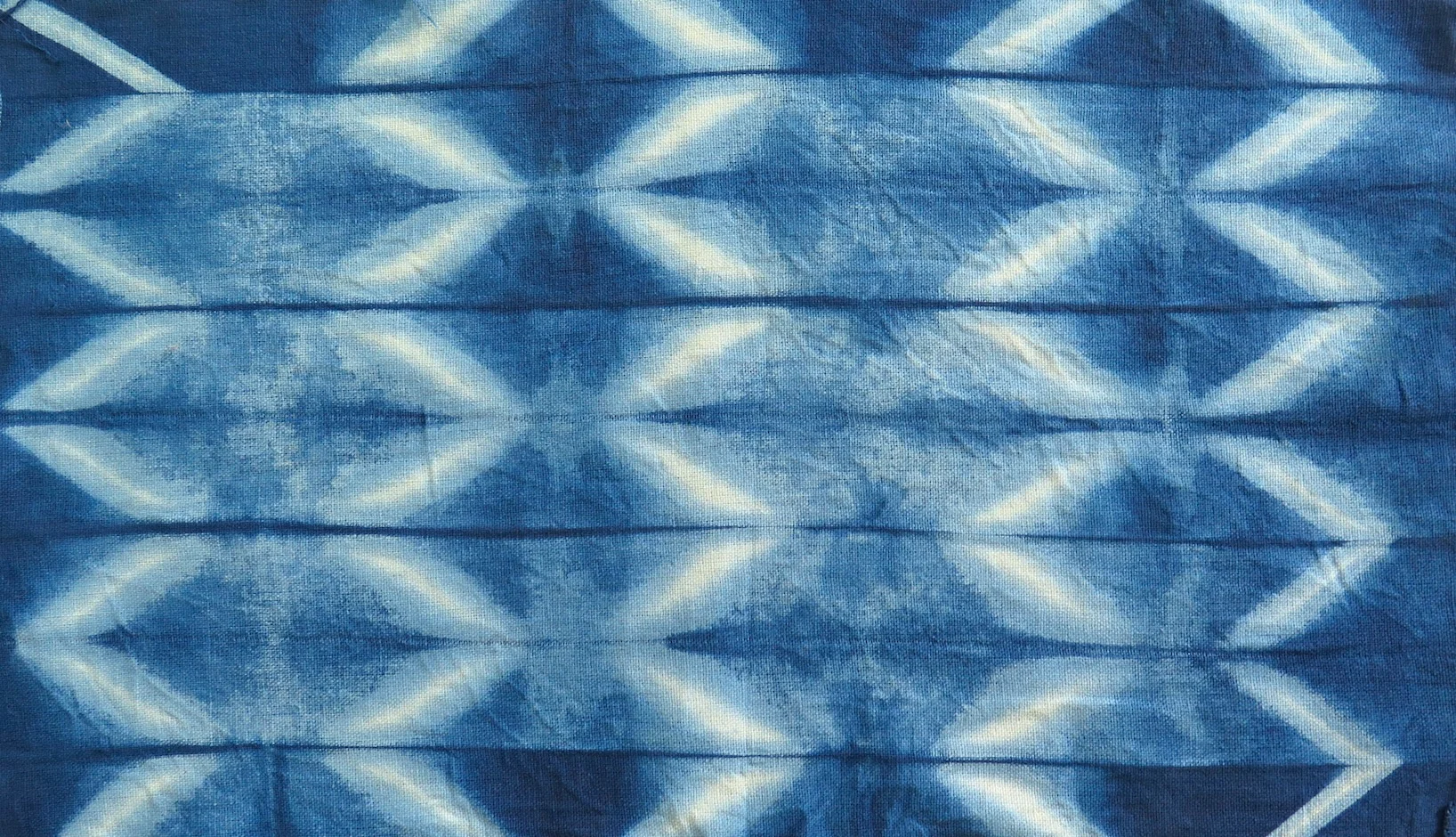
In Japan, the shibori folded fabric is traditionally dipped in an indigo dye vat to create deep pure blue. The indigo is extracted from various plants that grow around the world, mainly Japanese indigo, Indigo Fera Tinctora, and Woad.
Learn more about Plants & Colour Study Groups. During 2020 lockdown, Flora Arbuthnott of Plants & Colour gave a call out for a new Study Group series based around plants and colour, obviously enough! We began as we continue today, with each term or round running for a 6 month period and meeting once a month for a two hour Zoom call. Having signed up out of interest to connect with like-minded folks, I could not possibly have fore seen then just how important these monthly meet ups were to become to me.